What a moth knows about transformation that leadership books don’t
Last Saturday I walked through the Rhine landscape in Germany between the beautiful ancient city Zons and Schloss Benrath — a guided IVN nature walk and I was invited by my friend Hennie. A naturalist-educator lead our way, many different species of trees, the old riverbed next to our path.
And then, suddenly: this.
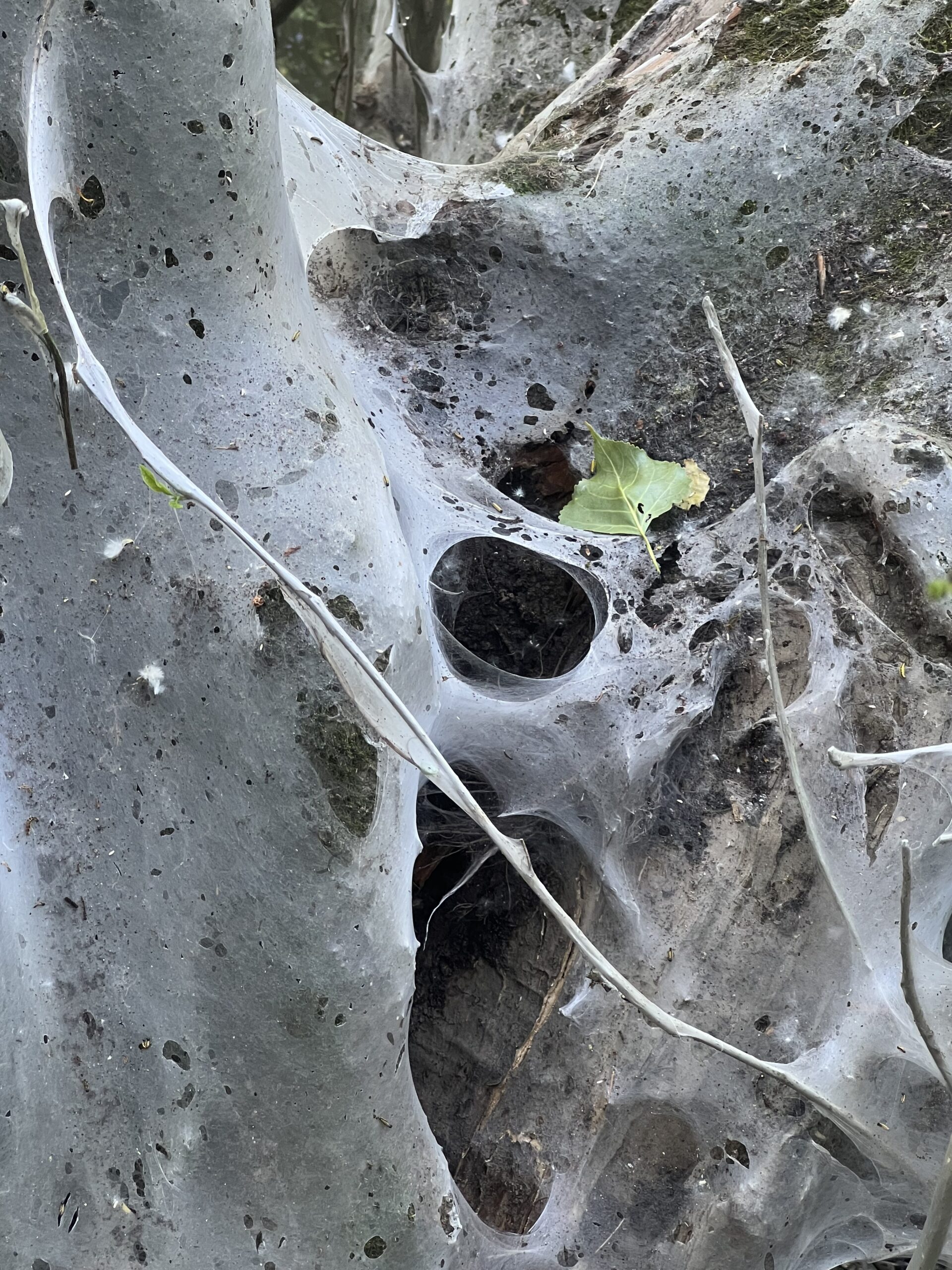
Entire trees wrapped in a translucent, silky veil. From root to crown. Every branch, every fork, every twig encased in what looked like fine white gauze — or industrial shrink wrap. Dozens of trees. A whole section of forest transformed into something otherworldly.
The ermine moth. Small caterpillars of 3 centimeters spinning collectively, building one vast protective structure. Inside: quiet transformation. Outside: the forest simply continues.
What struck me most, looking closer, was what the web wasn’t. It wasn’t solid. It wasn’t sealed. It breathed — full of hollows, tunnels, chambers. Porous enough to let air through. And between the white threads, new green leaves were already breaking. Life didn’t stop. It continued differently.
The phase nobody talks about
Most leadership development literature celebrates visibility. Show your vulnerability. Model authenticity. Let your people see you struggle.
And there is real truth in that — eventually.
But there is a phase before that. A phase that rarely gets named. The phase in which transformation is only possible precisely because it is not visible.
The leader who is fundamentally changing but is still mid-process. Who is renegotiating his relationship with authority. Who has discovered that her way of connecting — warm, attentive, always available — has been a compensation strategy for two decades. Who is feeling, perhaps for the first time, what it actually costs to always be the one who knows.
That leader cannot simply bring this into the boardroom. Not out of shame. But because it isn’t finished yet. Not solid enough. Still too exposed for the open air.
What she needs is a web.
What the neuroscience tells us
This is not just metaphor. It is biology.
Neuroplasticity — the brain’s capacity to form new connections, release old patterns, build new ways of being — does not happen under conditions of threat. Even subtle social threat. Even the low-level hum of am I being assessed right now?
When the nervous system detects threat, the amygdala takes the lead. The prefrontal cortex — responsible for reflection, nuance, the integration of new meaning — steps back. In that state, deep pattern change is neurobiologically close to impossible. You can perform differently. You cannot yet be differently.
The protective structure is not a luxury. It is a neurological precondition.
There is a second mechanism at play. The brain operates in two broad modes: focused, task-oriented attention — and what neuroscientists call the Default Mode Network (DMN), active during rest, reflection, and the quiet processing of experience. Genuine transformation largely happens in the DMN. Not during the meeting, but after. Not during the presentation, but in the early morning stillness, or on a long walk through a Rhine forest.
Leaders who give themselves no protected space also give their brains no opportunity to integrate what is shifting.
And there is a third factor. Newly formed neural pathways — new behavioral patterns, new beliefs about the self — are most fragile at the beginning. They need repetition in low-threat conditions before they become robust enough to function under pressure. A leader who exposes a nascent pattern too early to the weight of organizational expectation risks it collapsing back into the familiar. Not through lack of will. Through neurobiology.
The ermine moth’s web is not retreat. It is an optimal environment for learning, growth and transformation
What protective strategies actually look like
In practice, the protective web of a transforming leader rarely looks dramatic. It looks like this:
The trusted circle. A small group — a coach, a supervisor, one honest colleague — who see the real process and hold it carefully. Outside, nothing appears to have changed. Inside the circle, the actual work happens.
This is where I see supervision at its most essential. Not as a corrective mechanism. Not as professional maintenance. But as the web itself: a structured, boundaried space where a leader can be mid-transformation without having to perform competence. Where the question who am I becoming? is not a threat but the actual agenda. Where co-regulation — the nervous system settling in the presence of another who is not frightened by what is emerging — makes neurological change possible in the first place.
Most leaders have never had this. Many don’t know it exists. Some discover it and say, quietly, that it changed everything.
The maintained routine. The leader keeps familiar patterns intact externally — the weekly team meeting, the recognizable communication style — while something fundamental is shifting internally. The routine is the web: it offers predictability to the environment and breathing room for what is underneath.
The strategic retreat. A sabbatical, a silent period, time framed as ‘strategic reflection.’ The world accepts this from leaders. And within that space: the real inner work. Not thinking about the organization’s strategy. Thinking about the self.
The language of exploration. Leaders who frame their transformation as inquiry — “I’m exploring a different approach” — create a semantic shield. It makes vulnerability socially legible without requiring the full weight of the transformation to be named.
None of these are avoidance. They are — when used with intention — sophisticated self-regulation in service of genuine change.
The moment of emergence
The ermine moth leaves its protective web at the moment transformation is complete. Not before — it would die inside. Not after — it would miss its window entirely.
For leaders, the same timing applies. The protective structures are not permanent. They are functional for the duration of the process. At some point — when the new pattern is stable enough, when the new identity has become liveable — the leader must become visible in their new form.
Not as performance. Not as announcement.
But because the organization needs to see it.
A leader who transforms and then allows that transformation to be visible gives the people around them something that no strategy document, no culture programme, no leadership competency framework can provide: living proof that change is possible. That the brain can rewire. That it is never too late to lead differently.
What makes that emergence possible — what I have seen again and again in my work with leaders — is not talent or motivation or the right methodology. It is having had a protected space long enough, and a thinking partner skilled enough, to let the process complete itself.
The web does its work. Then it is time to fly.
Did you walk through a forest and find something like this? Or do you recognize — as a leader or as a coach — the moment when someone needs to spin their web before they can emerge?
I’d love to hear what you see.
Sonja Vlaar is a neuroplastician, executive coach and senior supervisor. She walks forests, asks hard questions, and believes that the most important leadership development happens in protected spaces — not on stages. She works with professionals and leaders individually and in group supervision. Based in the Netherlands. www. attune.nl ; https://substack.com/@sonjavlaar