Warmth Before Force
This week, Europe is in the grip of a heatwave. The thermometer reads 35 degrees or more. The sun is literally driving us out of our clothes.
Which makes this the perfect moment to talk about warmth — and why it works better than force.
Aesop knew it first
There is an old fable by Aesop about the sun and the wind. One day, they argued about which of them was more powerful. Seeing a man walking below, wrapped in a coat, the wind claimed it could make him take it off.
The sun accepted the challenge.
The wind blew harder and harder. But the stronger it blew, the tighter the man pulled his coat around himself. Then the sun took its turn. It simply radiated warmth. Gradually, the man loosened his grip and removed the coat on his own.
I return to this fable often. Not because it is charming, but because it captures something important about how people change.
The wind is not entirely wrong. It wants a result and applies more force to get it. But it misunderstands what it is working with. When people feel threatened, they rarely become more open. They become more protective. They defend, withdraw, resist, or tighten their grip on their metaphorically coats.
And often this happens before conscious thought has a chance to intervene.
The man’s grip on his coat is not a deliberate choice. It is his body’s immediate response to a perceived threat. The wind fails because it treats a living person as a problem to be solved. We cannot simply understand people as objects to be acted upon. We are embodied beings. The sun succeeds because it works with the body’s own intelligence.
But what does it actually mean to work with that intelligence?
How does a practitioner — coach, supervisor, leader — learn to recognize it, rather than override it? That question has stayed with me throughout my career. And my answer, perhaps unexpectedly, begins with theory.
A compass, not a terrain
Theory and methods are not decoration. They are a compass. Helping us understand not only what is happening in a conversation or a relationship, but why and what kind of response that calls for.
Without that compass, we risk explaining the person faster than they can discover themselves.
Worse, we may find ourselves doing exactly what the wind does: applying more technique and tools, more structure, more intervention, while the person in front is simply pulling their coat tighter.
Philosopher Edmund Husserl described theory as a horizon: a background understanding that allows us to make sense of what we encounter. A horizon does not tell you where to step. It orients you. It keeps you from losing your sense of direction when the path becomes unclear.
But Husserl also warned against allowing theory to arrive before experience. Meet what actually is present before reaching for a framework to explain it.
The compass matters. But the terrain still has to be walked.
The felt sense — Gendlin’s quiet revolution
One theory that has shaped my practice is Eugene’s Gendlin’s method of Focusing.
About 20 years ago (sic!) , I wrote an article about focusing. I did not know that it was the beginning of my interoceptive work as a profession. But it was.
Gendlin observed that beneath our thoughts and emotions there is often a deeper bodily knowing— something that he called the felt sense: a vague but meaningful bodily awareness that has not yet fully formed into words. A felt sense is not an emotion. An emotion is a culturally named grouping of sensations. A felt sense is more subtle — layered, complex, and difficult to describe. It takes patience to notice. But when we do, it often reveals what is really happening beneath the surface of a conversation, a relationship, or a stuck place in the biology of the body.
This matters because the body signals first. Sensation arrives before feeling, feeling before emotion, emotion before story. By the time we have language for what is happening, the body has already been trying to tell us for some time.
Learning to read that signal — rather than override it — is, in my experience, one of the most important things a coach or supervisor can help develop.
Attune’s Brain-Based, Heart-Led approach — in Dutch: Hoofdzaken die het Hart raken — draws on Gendlin’s work and approaches from phenomenological ontology and neuroscience-informed practices.
Head and heart are never opposites to be managed. They are two voices in a living system and ongoing dialogue. Lasting change — in human beings— emerges when both are genuinely heard.
Finding your niche
Professional coaches and supervisors need to be aware of the theories they draw on in their work. More than that — they need to be able to express this in words their clients can actually use.
My favorite clients are coaches who come to supervision precisely to find their own professional niche. In nature, a niche is not a corner you squeeze into. It is the precise set of conditions under which a living being — you— functions at its best — and in doing so, contributes something irreplaceable to the world around it. The same holds for the professional practitioner. No two practitioners occupy the same niche. Not because rules forbid it, but because no two brain-body systems the same. Over time, what makes you different as a practitioner often becomes your greatest professional advantage.
Naming that difference is not self-promotion. It is clarity. And clarity is what allows the right client to find you.
Brain-Smart, Practice-Wise
“A book starts a conversation. It rarely finishes one.”
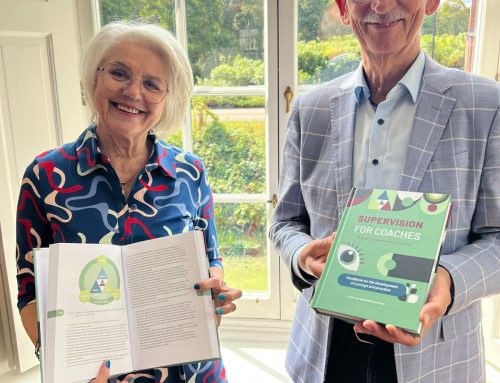
That is why, alongside the publication of the new book Supervision for Coaches: A Quality Assurance for Coaching, I am launching Brain-Smart, Practice-Wise: a companion webinar series exploring the book chapter by chapter.
Each session combines a short introduction, reflection, discussion, and practical application. Read the chapter, then deepen the learning together across ten sessions.
The series is designed for supervisors, coach educators, and professional coaches who are currently in supervision or considering it as part of their development and in the process of finding their own niche
If this is for you, you are warmly invited. For more information or registration, go to this page.
I look forward to these conversations — with peers who care about coaching quality and reflective practice. The book is a beginning. The webinar series is where the book comes alive.
Stay tuned, Sonja
Sonja Vlaar is an executive coach, coach supervisor, and neuroplastician. She works at the intersection of applied neuroscience, coaching, supervision, and leadership development . www.attune.nl